An Israeli airstrike on the Palestinian refugee camp of Ain al-Hilweh in Lebanon killed 13 people amid escalating Israeli bombardment across Lebanon, threatening the ceasefire with Hezbollah – which Israel has already broken dozens of times.
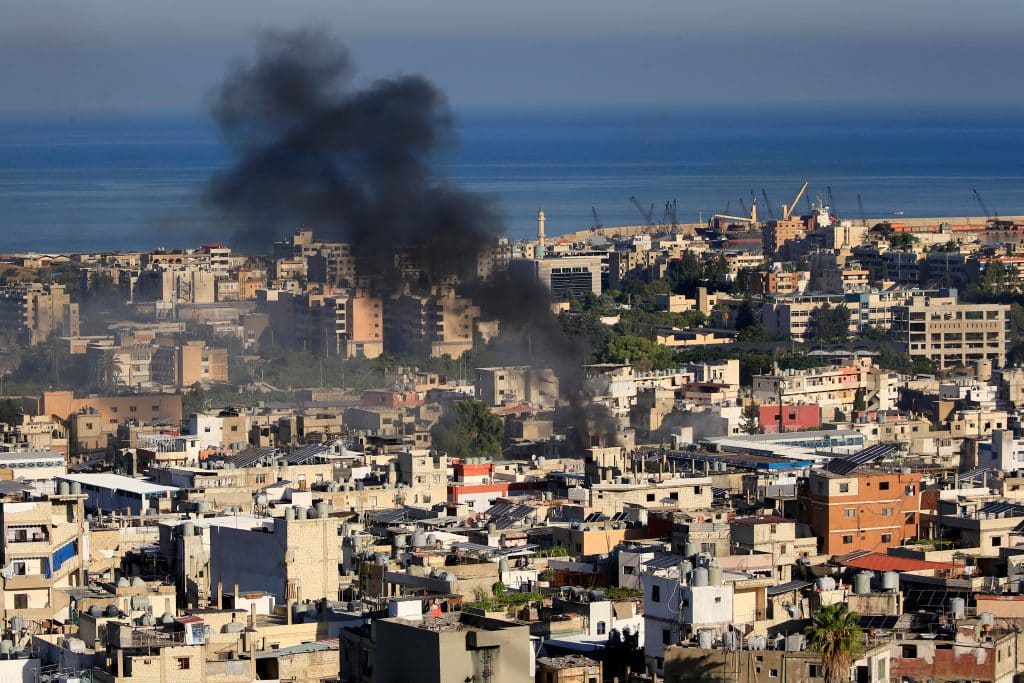
Yesterday, Thursday, November 20, the residents of the Palestinian refugee camp of Ain al-Hilweh, located on the outskirts of the Lebanese coastal city of Saida, marched in the funeral procession of 13 boys and men martyred in an Israeli airstrike two days earlier.
At around 9:20 p.m. on Tuesday, November 18, an Israeli airstrike tore through what had been a quiet evening: Palestinian youths playing football in a closed court near the entrance of the camp. In WhatsApp groups, witnesses described scenes of carnage and scattered limbs. More than 24 hours later, an official martyr count was announced: 13 people had been massacred while playing football.
The Israeli occupation forces released footage of the strike and said it had hit militants operating and training in what it described as a “Hamas training compound” inside the camp, a claim the Palestinian resistance movement strongly denied in a series of statements on Tuesday night.
“What the occupation targeted in the Ain al-Hilweh camp is an open sports field frequented by youth from the camp,” Hamas said. “It is known to all residents in the camp.”
Hamas called Israel’s military claim a “fabrication,” stressing the group does not operate training facilities inside Lebanon’s refugee camps.
The airstrike killed a group of young boys who were present in the field, stoking fears that an already fragile ceasefire between Israel and Hezbollah — signed almost a year ago — could collapse as a result.
Israel escalates airstrikes across Lebanon
According to the Lebanese National News Agency (NNA) three missiles struck the Khalid ibn al-Walid mosque car park and an adjacent sports court. The agency initially reported four deaths and a large number of wounded, launching calls for blood donations at nearby hospitals. Meanwhile, rescue teams worked through the night before the official death toll stood at 13 Palestinians, according to the Lebanese Ministry of Public Health.
Maryam Moussa and her children were sitting in their home when the strike took place. “People were just having a peaceful evening and suddenly, we heard sounds of strikes coming from the area of the football court, and it was followed by a loud and clear sound of fighter jets.”
Mariam explains that the football court targeted was a hub for the young people of the camp. “This is a football court open to everyone and known by everyone. These young men were just playing football, and this court is frequented by almost everyone in the camp — children, boys, men, teenagers, youths…they all go there for recreation,” Marian tells Mondoweiss. “There’s also a playground for smaller children, there’s a pool, and there’s a small sandwich shop next to it.”
“I thought someone was playing with fireworks,” Mariam recounts. “But then the house shook, and I thought maybe they hit somewhere close in the area, but not the football court! The flames were so strong it was as if it was right under my house!”
Mariam says that the shock everyone felt was intense, recounting that her children started running towards each other, thinking that the other was at the court, which is one of their frequent haunts. One of her sons went with the rescue teams.
“He ran through the flames so that the bodies wouldn’t melt and become unrecognizable,” she says.
In the aftermath of the attack, thousands marched through Ain al-Hilweh refugee camp in Saida and Shatila refugee camp in Beirut, condemning the massacre and the Israeli occupation.
Ahmad Abdel Hadi, 37, the coordinator of the Jafra Association in Ain al-Hilweh, says that 30,000 people participated in the funeral procession. “People cried a lot,” he told Mondoweiss. “There are many political differences in Ain al-Hilweh, but this airstrike united people and brought everyone together.”
“These young martyrs did this; they forced us to overcome our differences and made us realize that they are only temporary,” Abdel Hadi added.
Within hours of the attack on Tuesday, all Palestinian factions and groups released statements condemning the massacre; Lebanese authorities, by contrast, have remained publicly silent as of the time of writing, even as widespread strikes hit southern Lebanon the following day. UNRWA schools in Saida and several private schools in the region announced a closure and a state of mourning the following day, with a general strike taking place inside the camp.
The Ain al-Hilweh massacre came amid a wave of cross-border violence that risks spiralling into broader confrontation. The day after the attack, Israeli occupation forces intensified strikes across southern Lebanon, issuing evacuation warnings to multiple villages and causing widespread fear and chaos. One earlier strike that day hit a vehicle in Tiri and injured students on a university bus.
The massacre took place a day after the UN Security Council approved U.S. President Donald Trump’s 20-point Gaza “peace” plan, which sanctions the formation of a so-called “International Stabilization Force” under the purview of a “Board of Peace” headed by Trump, which would oversee governance, security, and reconstruction in Gaza. Palestinians have condemned this arrangement and called it a renewal of the “mandate” system, a form of colonial imposition and foreign rule that erases the rights of Palestinians to self-determination.
The vote has only deepened Palestinian anger and skepticism toward international diplomacy, with many condemning the plan as imposed on Palestinians at a time when civilians continue to die.
Ain al-Hilweh is Lebanon’s largest Palestinian refugee camp. It was established by the International Committee of the Red Cross after the Nakba of 1948 to shelter displaced Palestinians from northern Palestinian towns. In 1952 the United Nations Relief and Works Agency (UNRWA) began operations there, replacing initial tents with more permanent concrete shelters and providing healthcare and education; UNRWA remains the camp’s primary provider of services. Over the decades, the camp has grown significantly and today houses more than 80,000 Palestinian refugees, whose housing and sanitation conditions, as well as their water and healthcare systems, have come under severe strain.
Mariam says that her children are still in shock. “The court is just one street away, and my children spend so much of their time there; it’s a bustling area,” she said. “Why? Why do this to us? Isn’t it enough that we’re displaced, that our land was taken away from us?”
“Children here don’t even dare to dream anymore,” Mariam added.
Free speech is under attack—especially when it comes to Palestine.
From the censorship of student voices to the assassinations of journalists in Gaza, the cost of telling the truth about Palestine has never been higher. At Mondoweiss, we publish fearless reporting and critical analysis that others won’t touch—because we believe the public needs to know the truth about Palestine.
We’re funded by readers who believe in justice, transparency, and freedom of the press.