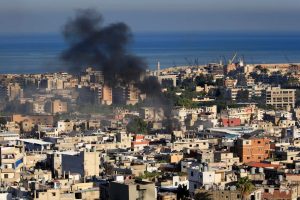
Israel is deepening Lebanese social rifts by bombing areas that have been considered historically “safe” from Israeli attacks, dissuading the residents of those areas from sheltering displaced people from the south.
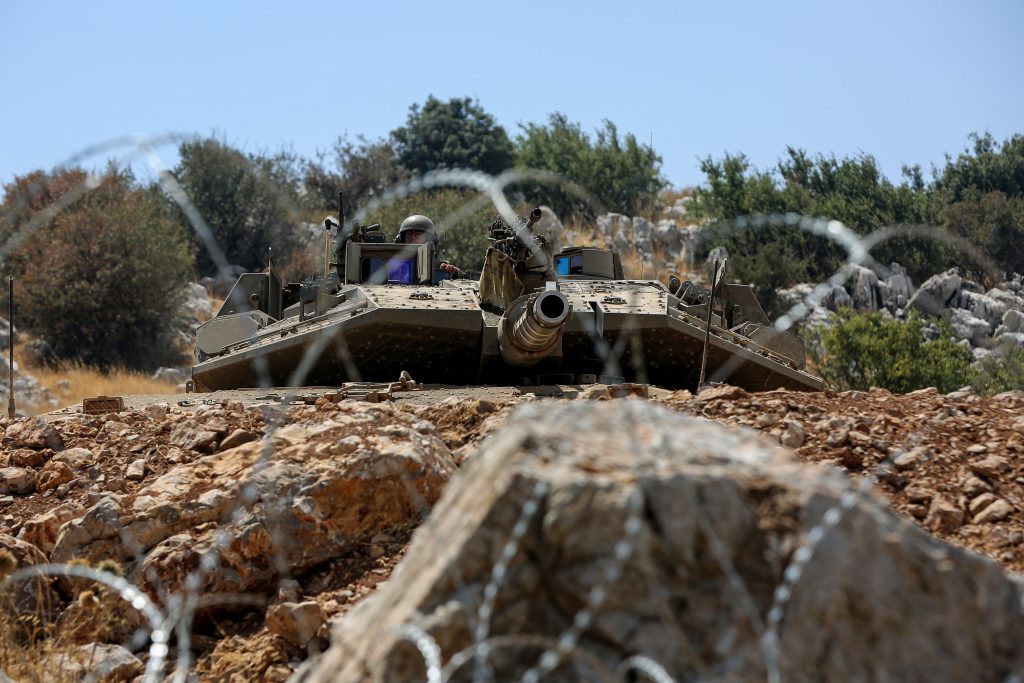
On Monday, September 23, more than 500,000 people were displaced from southern Lebanon after Israel launched a full-scale attack on towns and civilians under the pretext of targeting Hezbollah’s storage facilities. We’ve seen this play out in Gaza and we know for a fact that this excuse aims to manufacture consent to massacre entire families and destroy entire towns. The Israeli goal is clear: to rob the land and kill the people — while expelling those it cannot kill.
Palestine is not the only place Israel is trying to occupy under the pretext of a promised land. Lebanon has always been a target of Israel’s occupation forces.
At the same time, internal Lebanese social rifts and contradictions, which have been politically institutionalized in a confessional political system, are being exploited by Israeli forces to get Lebanese citizens from different sectarian and political backgrounds to turn on one another. On one hand, there are a large number of supporters of the resistance and liberation movements, while on the other, there is a far-right group that supports normalizing relations with Israel and markets “peace” as the only way forward. This same group is associated with the militia that massacred Palestinians during the Lebanese Civil War from 1975 to 1990, most infamously during the Sabra and Shatila Massacre in 1982 that took place with the help of Israeli forces.
Lebanon has experienced a surge in the uncovering of informants and collaborators over the past few weeks who have been caught on the ground by the Lebanese Security Forces. This has fueled speculation among people that the Israeli government has reached out once again to its internal supporters to create a deeper division within the Lebanese population. These Israeli attempts to sow division come at a time that requires full-scale unity and social solidarity rather than deepening social rifts.
By exacerbating the sectarian tensions that have long plagued Lebanon, Israel aims to weaken both the resistance and the broader society in service of the larger goal of invasion and occupation.
Exacerbating social fissures
When the first wave of the displaced from the south arrived in Beirut, many of them asked to stay away from the “Christian” areas, where they did not feel welcomed. But in times of war, the enemy is the same for everyone, and so is the threat. Those social rifts were overlooked for a while, and everyone opened their homes to friends and families from the South.
But it didn’t last. At the end of September, almost 5 days after the start of intense fighting, videos of a fight circulated online showing people refusing to shelter those whom they accused of having brought the war upon Lebanon. The altercation took place in Ain al-Rummaneh, a “Christian” street in Beirut where some people from the south had rented an apartment. Slowly and quietly, a number of displaced families decided to leave some of the Christian areas, once again under threat of homelessness.
Intissar is 24 years old. She’s from the south of Lebanon, where the majority of the people there are Shi’a Muslims. When the heavy bombing started, she and her family fled immediately. They didn’t know where they were going and just wanted to leave, expecting to find open homes for them in Beirut considering the state of war. “It’s not a war on us alone, it’s a war on all of Lebanon and everyone!” she told Mondoweiss.
Intissar said that once they arrived in a Christian area in Beirut, “I started noticing people looking at me strangely walking down the street because of my Hijab, but I didn’t understand why. Am I the first veiled woman who walks these streets?”
Intissar and her family started to get scared and limited their movements in the area. “At this point, we stopped being afraid of the war. We were just worried by people around us,” she said, explaining that she felt as if their presence was clearly rejected. Those fears were confirmed when two men they did not know knocked on their door one evening, threatening them and asking to speak with the owner who had rented them the apartment. “Immediately after that night, first thing in the morning the building owner called us and told us that we’re not allowed to stay in the apartment,” Intissar said.
“I don’t know if they think that the enemy [Israel] is only fighting one sect, but after that incident, we stopped looking for a safe place from the war — we started searching for a place that accepts us!”
“We always thought that if something like this happens, we would all be brought together, but this was much harder than the actual war we’re living through — being rejected by our own people,” she added.
This incident alone did not deepen the societal rift within broader Lebanese society, drawing widespread public condemnation of the event on social media amid calls for unity during this time. Volunteers from many different backgrounds continued to help displaced people, exemplifying the attempts of ordinary Lebanese citizens to bridge historic social cleavages.
But despite these attempts, the targeting of certain neighborhoods and buildings by Israeli airstrikes led many on the ground to believe that Israel was attempting to further the rift — by bombing historically “safe” areas of the city and hence aiming to dissuade the locals of those areas from taking in the displaced.
Exploiting sectarianism through airstrikes
On September 24, Israel attacked a house in Maaysra in the northern area of Lebanon, where the majority of inhabitants are Christians. Sixteen people were killed, seven of them from the south.
Then, on Friday, September 27, Israel targeted another house full of displaced people in a town in the Chouf area, Baadaran, whose inhabitants are mostly Druze, killing eight people from the same family. Later during the night, it attacked another Christian town in Mount Lebanon called Bhamdoun, with no casualties recorded.
An increased escalation took place on October 6, when Israeli forces bombed three houses full of refugees from the south: in Jiyeh, Kayfoun, and Kematiyeh. A few days later, on October 9, Israel targeted a residential apartment in a hotel housing displaced people in Wardaniyeh, also in the Chouf area.
And just two days ago, on October 12, another house in Maaysra was targeted in the same area as the September 24 bombing, killing nine and injuring 15.
All of these areas across Lebanon are historically considered “safe” from Israeli attacks. But most crucially, they are areas that have always opened their homes to displaced people during previous wars in Lebanon.
The message Israel wanted to send by targeting these areas was clear: if you house displaced people, you will be attacked.
Fake news and psychological warfare
In parallel to these attacks earlier in September, Lebanese people in many areas across Beirut and elsewhere started receiving text messages or phone calls on landlines asking them to leave their buildings or flee their locations immediately because they were close to a “Hezbollah facility.”
Some of these messages named specific buildings full of civilians in the historically “safe areas” of Beirut. For two days straight, fake news circulated over WhatsApp groups and via text messages on personal mobile phones, either asking people to evacuate immediately or asking people not to accept southerners in their towns or homes, as they might be Hezbollah members. People took these threats seriously and thought that they were from the Israeli army, leading to widespread panic.
After a while, it was discovered that most of these messages were fake. They were either sent by people “pranking” each other, such as a group of two young men who decided to prank their friend who owned a few buildings on a Sunni street in Beirut that housed displaced people, or by other more nefarious actors sending mass messages. Until now, it is still unclear who was behind the misinformation campaign. The Lebanese Internal Security Forces announced that they are looking into the incidents and will take appropriate measures to deal with the situation.
Whether the text messages were simply pranks gone wrong or a more sinister psychological plot, the timing of the incidents resulted in an even more terrified population, already on edge over the possibility of being bombed or displaced at any moment.
More recently, on September 30, another wave of fake news flooded the local and international channels about the “start of a ground invasion.” International channels would report “the beginning of the invasion,” while local channels would copy the news without verification, even though most local channels have war correspondents on the ground in the south. Right-wing media channels that politically aligned with the groups that massacred Palestinians during the Civil War — the same groups that today call for normalizing relations with Israel — immediately picked up the Israeli narrative and disseminated it without fact-checking. For an entire day, people thought that all of Lebanon was being invaded, but in reality, Israel had launched a “limited” invasion that was being actively pushed back and forced to retreat by the Lebanese resistance. The same thing happened a few days later when the Israeli army published pictures from a town it claimed to have invaded, only to be completely denied later in the evening.
Since the beginning of the “ground invasion” on September 30, the occupying Israeli forces have failed to permanently position themselves on Lebanese territory as of the time of writing. During the first two days of the vaunted ground invasion, eight Israeli soldiers were killed. An estimated 39 Israeli soldiers were killed between the start of the invasion to October 11, while the Israeli attacks killed over 2,255 Lebanese and injured over 10,524.
One of the most important aspects of this war is the Israeli campaign of psychological terror and media propaganda. The Israeli government is doing everything in its power to weaken and divide the social fabric of Lebanon, hoping to foment mass flight and social disintegration among those who remain.